• Home
  • Current Projects
  • About
  • Productions
  • impel theatre
  • Writing
  • Teaching & Workshops
  • Press
  • Blog
  • Blog Archive
Menu

Kendra Jones

director . writer . dramaturg . instructor
  • Home
  • Current Projects
  • About
  • Productions
  • impel theatre
  • Writing
  • Teaching & Workshops
  • Press
  • Blog
  • Blog Archive

impel theatre blog

Burgeoning academic.
Creator of things to read & experience. Thinks too much.
Analyzes everything. 

Reviews are meant to catalogue, interrogate, and challenge what I see.

All opinions are just that -- opinions. 

Pip Dwyer, Kaitlin Race, Jennifer Dysart McEwan in Watching Glory Die by Judith Thompson, directed by Kendra JonesPhoto by John Gundy

Pip Dwyer, Kaitlin Race, Jennifer Dysart McEwan in Watching Glory Die by Judith Thompson, directed by Kendra Jones

Photo by John Gundy


Sunny days ☀️
Happy Mother’s Day, Canadians 

#anarchyintheuk
Tangled.

Found in Commercial Street.
#london #spitalfields #streetart
Happy birthday @bonks21 ! If these pictures don’t exemplify our relationship, nothing does. Here’s to this summer’s European adventure which trades Scottish mountains for Parisian staircases.
❤️

Found in High Holborn, London
Just hanging out. 

Found in Commercial Street. 

#london #eastlondon #wheatpaste #streetart
Outside David Garrick’s house, on the banks of the Thames; his Temple to Shakespeare.

#hampton #temple #shakespeare
Saw Hate Radio at @batterseaartscentre - thought some things. You can read them on the blog, link in bio.

#theatre #archive #review #milorau #bac
Saw Book of Mormon the other week. Thought some things. You can read them on the blog- link in bio

📸: Prince of Wales Theatre ceiling
Our appetite and capacity to digest fragmented narrative is expanding.

@jordan.tannahill - Theatre of the Unimpressed 

#reading #theatre #mediums #mediation #experiences

tweets


Parnes_SB-UMH359.jpg

Split Britches: The True Story - Split Britches [Recorded 1984]

May 16, 2020

I watched this in recording via the Split Britches archive - available here.

It is so exciting to get to reach back in theatre history archives and see work from moments in time which create the trajectory on which my own work rests. Womens stories on stage, non-drama driven story, the mundane and every day presented on stage — these are all present. The Staging is reflective of a slide show, quick blackouts, choreographed minute movements between, reminding us of the artifice of presentation. Scenes repeat and circle back, seemingly static, yet things change.

I also loved the recording itself; it zooms in on small moments that may or may not be related to the speaking, allows the speaker to walk off screen while focusing on another character’s reactions. In the same way that a viewer’s eye in the theatre may linger elsewhere, this recording encourages us to acknowledge that, and provides space for this mental wandering. It is a reminder that the words are only a part of what matters — but rather that each minute detail makes up the whole.

A really wonderful piece to view for those whose work lingers in feminist ways of storytelling, to remind us of where we have come from.

Tags: Split Britches, Feminist Theatre, performance art, theatre, recording
14secondview-superJumbo.jpg

Sea Wall by Simon Stephens [Recorded 2012]

May 14, 2020

I watched this in recording - it is available here until May 18 for free, or to purchase via www.seawallandrewscott.com

Quarantine is confronting me with many uncanny encounters with scripts I know inside out, as performed in their first production, which due to living in the hinterland, did not get to see. In 2015, I co-directed the Canadian premiere of Sea Wall, featuring the brilliant Rodrigo Beilfuss. I adore Simon’s writing in general, and in particular in this script. It’s powerful imagery, it’s subtle, wave-like rhythms that wash over Alex and the listener, mirroring the way grief creeps in and out of our consciousness.

I had not before seen Andrew Scott’s performance of it. Filmed after the show’s runs in London and Edinburgh, in an empty photography studio, this version of Sea Wall is wonderfully static and contained. Although Andrew moves about the space, the vantage point remains still, fixed. He becomes blurred at times, a beautiful subtlety in the recording which underscores the Alex’s feelings (and our own) of being completely subsumed by the tragedy of the dramatic moment.

One of the things I love best about this script is that although it is extremely active — he is working through his grief — it is also still. All of the action, all of the tension, occurs off stage (in fact, in the past) and rather than seeing things happen, we witness a man dealing with the fall-out of those occurrences, wrestling with his past and what it means for his future. Things that were said. Events that occurred. Loss.

Andrew Scott’s performance is thoughtful, present, and simple. The rawness of the thought process as he works through the events, builds and weaves this story, are breathtaking.

This is some of the finest writing you’ll find, performed to perfection.

I can’t help but compare it to our own interpretation; ours would have likened better, I assume, to the stage presentations in London or Edinburgh, in a small, stuffy, simply lit space. Just an actor, an audience, and this story. One thing that, for me, the recorded version is missing is the collective gasp of realization, the moment when the shoe drops (of what the hell he is even talking about) just over two thirds in. In a room with about 35 other people, the power of that moment literally sucked the oxygen out of the room. You could feel the collective gasp and unwillingness to exhale. The audience completely captivated by this moment, this story - unsure of how to act. Perhaps it is because I watched it with my family (who of course had seen it) but I missed that. That moment, that unwillingness to exhale, as exhalation on the part of the audience is an act of complicity, of needing to see where this story ends, despite already knowing deep down what comes next.

That is the magic of the collective experience.

Tags: theatre, Sea Wall, Simon Stephens, Andrew Scott, review, recording
V6+WEVasQsaekPSHn5EIrA.jpg

End Meeting For All - Forced Entertainment

May 10, 2020

I watched this in recording. You can watch Part 1 here. You can watch Part 2 here. Both are available until June, and Part 3 airs May 12.

Disjointed. Unfocused. Overwhelming.

Forced Entertainment’s End Meeting For All series are improvised public group calls between company members isolated in their homes. Each begins abruptly, and ends abruptly, yet despite the improvisational nature, a structure appears. People ignore others in the call. People get distracted and wander away. People remain deeply focused on a single object or question to the point of irritation. Technology fails (or does it?).

This reflection of our time, when interaction with our closest friends, colleagues, and family members is largely through the blue-white glare of a computer monitor, is stunning. Forced create a piece of performance that is at once anti-performance, and high-performance. We are all living in this recognizable yet utterly foreign version of our world. It is funny, it is sad, it is at times bleak.

This is theatre for isolated times.

Tags: review, new work, fail, failure, performance, forced entertainment, improv, performance art, experimental theatre
imgtoolkit.culturebase.org.jpeg

Anatomy of a Suicide by Alice Birch [recorded 2017 - SchauSpielHaus]

May 05, 2020

I watched this in recording here - although this production isn’t up any longer, there are more great productions to see.

Alice Birch’s script traces three generations of women over top of one another, through similar moments in their lives. The three timelines occur concurrently, with single conversations existing within each, yet also across - with a response in one timeline seeming to call to a question in another, across decades. Choosing to position the three women in claustrophobic columns, each with their own upstage door, no walls yet feeling clearly they could not leave, in chronological order left to right (from audience view) the matriarch is positioned as having the most power, however as we see, it is the youngest who acts upon her power, where her mother and grandmother succumbed to mental illness.

Alex Eales’ set makes each woman’s room feel like her prison cell, and Katie Mitchell’s direction, keeping the three on stage for the duration, including costume changes which are choreographed and lit as the women stand there like paper dolls awaiting their new outfit. It seems to imply the that each is imprisoned, contained, controlled - almost devoid of the capacity for choice. Strangely, not realizing this was the same designer who did Katie’s Fraulein Julie, this set did make me think of that production as well.

What wasn’t perfectly clear was how and why the youngest is different, until the final moments - deviation from the same choreography and rhythm may have helped us see this capacity to break the cycle, imply its possibility. I wonder whether this could have been baked subliminally into that choreography.

Otherwise, this was a stunning production of an unbelievably challenging text. The rhythm and technique required, while balancing a delightful liveness and action, even in moments where the actor must technically pause for another line, while maintaining intent, was beautiful and an absolute treat to watch.

This was a re-mount of the same production, but with a German cast. I’d be very curious to see the English cast version (Royal Court) as well.

Tags: Katie Mitchell, SchauspielHaus, recording, review, Alice Birch, new writing, Royal Court
spymonkey complete deaths bloodbath-5137 ls-crop.jpg

The Complete Deaths by Tim Crouch & Spymonkey [Recorded 2016 @ Shoreditch Town Hall]

April 21, 2020

I watched this in recording via Spymonkey’s Vimeo account - you can watch it here until April 25. (if it asks for a login, just create a vimeo account, and it will credit you the amount). Note: there are 2 parts.

This is what I needed in isolation. Wild, silly, irreverent, a bit mad. This show does…yes…the complete deaths. All of the onstage deaths in Shakespeare’s plays, acted out in various styles by the company, through a debate over what kind of work they are making. Using the aid of video cameras and projection, musical instruments, and a zillion props, the company make light of the darkness in the plays, showing the strangeness and absurdity of the plays in their most serious moments.

This is fun. it is irreverent. I don’t honestly know what else to say, other than watch it. You will laugh out loud. You will wonder what is going on. And you’ll enjoy it.

Tags: theatre, review, Tim Crouch, Comedy, recording
B6A3AF62-B535-4C4E-9410-E64AF211FA35.jpg

Endless

I was commissioned by Convergence Theatre to write a piece inspired by phone calls and messages people were invited to share. . . their COVID-confessions. What follows below is original writing, by me, in response to two of those confessions.

Endless - A meditation on isolation, commissioned by Convergence Theatre

April 13, 2020

A meditation on isolation

By Kendra Jones, commissioned by Convergence Theatre


She sits on her sofa. Resisting the temptation to open her laptop again, to scroll again, to get sucked in to the endless sea of images. News clips, photos of someone’s kid. Memes. So many fucking memes. 


  /Facebook ding. 


Ignore it.                                          Ignore it. 


Her mind drifts. . . she catches her reflection in the window.
She smiles.
She wonders, is that weird? 
Smiling at yourself?
At your reflection?                                                                   The vanity. 


  /Skype sound.


With the alarming digital noise now looping, far too loud into her living room, she realizes she hasn’t spoken to another person in three days. Like actually spoken words aloud. Her cat doesn’t count. Should she answer? 


She pauses. 


On the one hand, it would be lovely to see someone, even digitally. 

To hear someone breathe. 

To see them smile. 


On the other hand, she acknowledges quietly, in her mind, that she hasn’t showered in those three days either. Her voice will probably be raspy from non-use, then she’ll have to explain that she isn’t sick. 


Might just be easier to. . . 


  /Skype sound stops. 


There was this time. . .  back, before. . . whatever this is. . . she was on her way to work. She took an unusual route that morning. As she transferred from the streetcar to the subway, she walked past a few homeless people sitting on the ground. She smiled if they caught her eye, feeling sheepish for never carrying change or a granola bar in her bag to offer, suddenly self conscious of her privilege. As she turned the corner, a woman looked at her with eyes that pierced into her soul, immediately seeing this self consciousness, and said aloud, “she knows what it means to dress herself in black”. That sentence rang through her head the rest of that day. 

It wasn’t upsetting. It was nice. 

Almost comforting, really.

To be seen so clearly, so quickly. 


It is hard for her not to wonder whether that will ever happen again. . .
Will we ever go back to real interactions? 


Will it ever be comfortable to look someone in the eye again? 

To brush up against them by accident, or sit back to back in a crowded cafe?


Will we ever sit in theatres or on transit, near to one another, to strangers again? 


She wants to believe we will; that this forced only-online time will make us value real interaction more. Value closeness to those we love. To strangers. That if this ever ends, she won’t see couples on dates in restaurants looking at their phones, but instead looking at each other. Really seeing one another, deeply, honestly. 


The weight of unproductivity sits on her shoulders as she realizes she is scrolling again. 


                  She scrolls and scrolls. 


How are there people thriving in this time?

Tags: Convergence Theatre, COVID, commission, new writing, poetry, new work
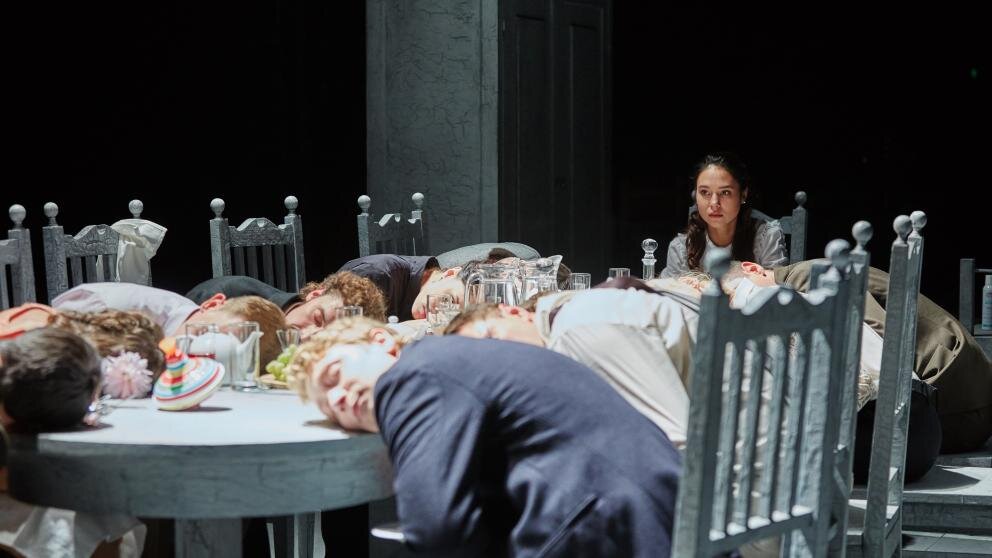
Three Sisters 5_2.jpg

The Three Sisters - Red Torch Theatre (recording - via Stage Russia HD)

April 06, 2020

I watched this via Stage Russia HD, however it was available there only for a limited time. It is also available (For a fee) via Digital Theatre subscriptions.

I first read about this production last year, when researching Timofey Kulyabin as his production of Ivanov was on at Barbican during a visit. You can read my thoughts on that production here. His production of The Three Sisters is almost entirely non-vocalized; the characters, aside from Ferapont, speak in sign language. This does not mean it is silent, however. The production has a detailed score that creeps on you. At first it is high heels clicking on the floor, or floor boards creaking. It is characters playing a game in the next room, or Andrij practicing the violin. Toys squeaking, dishes clanking, clocks ticking - all the sounds of life. This score swells and rescinds magically as the story goes on.

The set enables us to see all the rooms of the house at once - a large open space, with smaller rooms set up and demarcated using lines on the floor, like taping out a set, except that it doesn’t grow upward. These lines do stretch upward in the imaginations of the actors, however, who peek around walls, and behave as if they are there. Thus while a scene may be occurring in one area, wordless, the sounds from another room emphasize, engage, and intentionally distract from what is at play. These sounds make the relationships between the characters clearer than they have ever been.

We see Natasha fretting and primping while Masha broods. We see Irina lamenting her boredom with the choices available to her, while we see servants working around her.

The production is placed now, but also not-now. Characters receive messages on smartphones, and these devices are even used to light an entire set of scenes after the fire, the eerie blue glow of digital interaction a haunting reminder that our own times are not so far departed from those of turn-of-the-twentieth Russia.

The boredom, the excess…these were all too prescient as we sit here in our collective spaces. So many of us with the privilege of boredom, of devices to be bored of, while those less fortunate must go out and work in these dangerous times, risking their lives to deliver us sushi or mcdonalds or groceries in the comfort of our homes, so WE don’t have to go out.

Most striking were the moments, well chosen by Kulyabin, where the movement and sound stopped entirely, and we saw the characters just sit and wait, only the sound of a ticking clock to accompany them. The show was truly striking, comfortably holding your attention despite its 4 hour running time. The time flew by. Yet didn’t.

Tags: Theatre, Red Torch Theatre, Stage Russia HD, Timofey Kulyabin, theatre, recording, review
image.jpg

Richard III - Schaubuhne Berlin (recording)

April 04, 2020

I watched this recording of the performance via the Schaubühne Berlin website; they are making one show per day available, find them here.

This blog is quickly devolving into a Lars Eidinger/Thomas Ostermeier fan account, and I’m not sad about it. I skipped the live stream of Hamlet, having seen it live in 2012 at Barbican, in favour of seeing another interpretation, their Richard III. It did not disappoint.

This is wild Shakespeare. Messy, beautiful, visually poetic Shakespeare where the extremity and heightened images and physicality match the height of the language. Every time I watch a German production of Shakespeare, I’m reminded of how safe the work here in Canada and in the UK can be. How Bardolatry has superseded everything else; how if you do something other than stand and speak the words, somehow you are not “doing Shakespeare”. These productions are here to remind us that isn’t the case, nor is it necessary.

The industrial nature of the set, mashing images of high society ballgowns and suits with German club culture, and a warehouse aesthetic underscore how Richard is different from those around him. This Richard is plainly manipulative; we see the props and prosthetics that create his difference as items clearly clipped on to him. We see him manipulating his physical appearance, and using that to manipulate those around him. His early scene with Anne isn’t him seducing her but rather deploying his vulnerability into making her feel responsible for him - a choice which for me actually helps to rationalize Anne’s choice to marry him (especially when viewed from a modern context).

Finally, by re-framing Richard as a manipulative sociopath rather than a power hungry wannabe leader, the final battle scene re-positioned as occurring entirely in his mind, we simultaneously feel pity and revulsion for this terrible self-interested human.

The use of sound design and projected visuals on top of the industrial space further created a sense of the scale of this world. This is magnificent, huge, epic Shakespeare.

Tags: Schaubuhne, Ostermeier, shakespeare, review, thoughts, recording
cyprus avenue.jpg

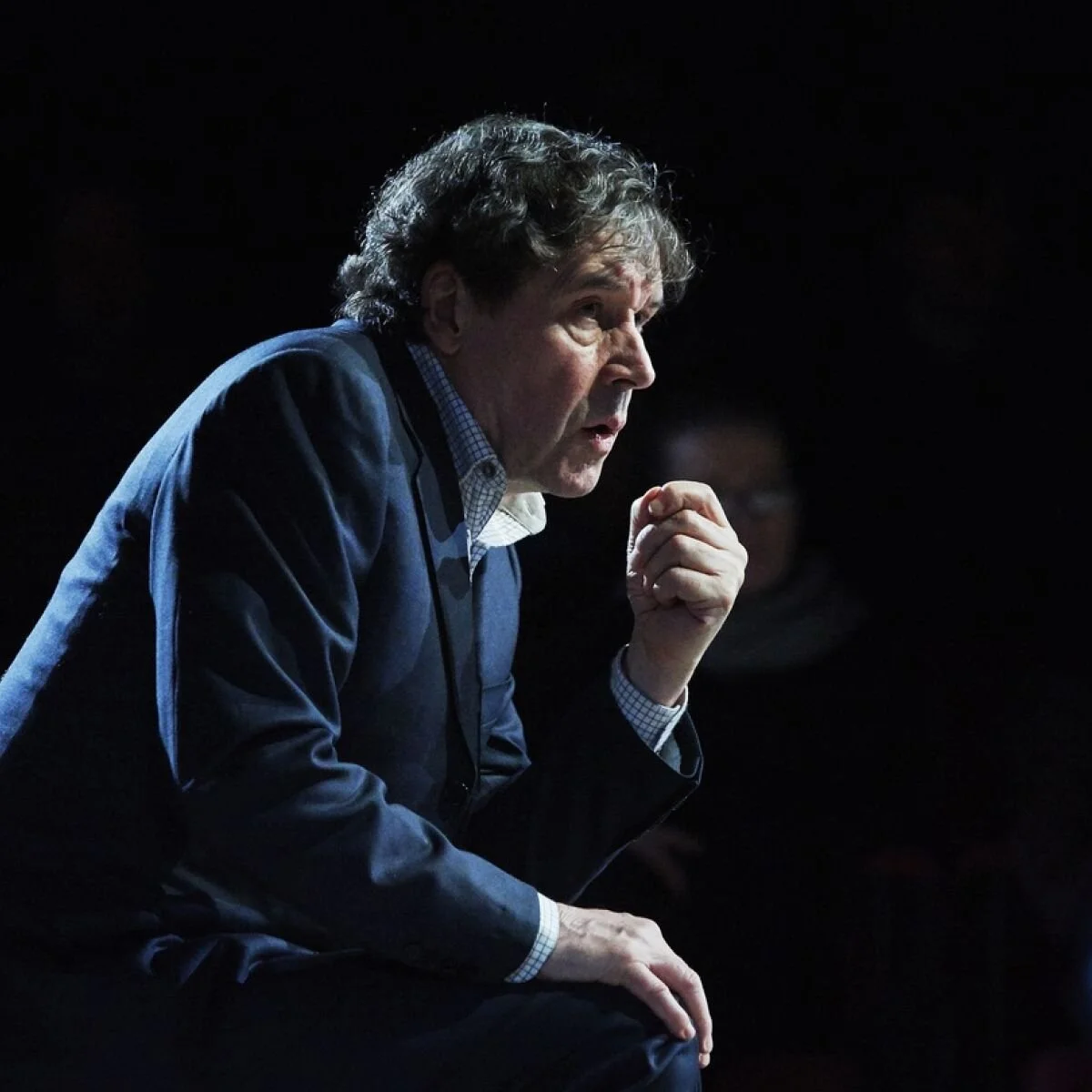
Cyprus Avenue by David Ireland - The Royal Court (recorded 2017)

March 30, 2020

I watched this in recording from the 2017 Royal Court production. You can watch it here until April 24.

This is a gut punch of a play. Funny, shocking, dark, David Ireland examines personal identity and how it is deeply intertwined with a sense of where you are from. The story focuses on Eric, an older male who grew up in Northern Ireland during the Troubles, whose very identity is defined by them. He actively defines as NOT Irish, as NOT Fenian, while struggling with a new world where those older tensions are relaxed. It is a meditation on masculinity, on systemic and inherited violence.

Vicky Featherstone’s direction surprises, managing the pace of the story and time shifts in a way that creates jarring moments. We are lulled into believing we’re in one place then quickly jolted to another. The square, white playing space is increasingly messy as the play goes on and the tension escalates, leaving a clear and visible mark, representative of the invisible marks the violence of his youth has left on Eric.

The ensemble are uniformly strong, each bringing a balance to surround Stephen Rea’s riveting and powerful performance. The miniscule and momentary shifts in his performance are truly stunning.

I won’t say more for risk of revealing the surprises in the text. Just watch.

Tags: Royal Court, review, recording, Vicky Featherstone
10869610_10154954444620511_9104971064809033399_o.jpg

Hedda Gabler - Schaubuhne Berlin (recorded)

March 28, 2020

I watched this streamed from the Schaubuhne website. You can watch it here until late in the evening Mar 28.

I won’t lie; i’ve been obsessed with this production purely based on still photos and written reviews for approximately 6 years. So when I learned that Schaubuhne were offering it in their nightly streaming during the theatre’s closure, I blocked the day.

It did not disappoint.

Initially, Jan Pappelbaum’s striking and majestic design strikes you. The sheer opulence and glamorous veneer of the Tesman house is magnificent. The walls rain. The apartment, although open and airy, feels claustrophobic, emphasized by the revolve, and the mirror positioned above the stage, so that even when a character is in another room, they are visible. This world is inescapable. Stifling. Director Thomas Ostermeier has laid his trap.

Lars Eidinger’s Tesman is bumbling and sweet, clearly enamoured with Hedda, who is visibly disgusted by him. The fact that she is so, just contributes to her petulance. She is like a tempestuous teenager, whom everyone is simply trying not to set off, while infantilizing her. Katharina Schüttler is magnetic. Even moping around in pyjamas, her playful yet sadistic nature is at once intimidating and sexy.

The balance of the other two men in her life - Jörg Hartman’s slimy smooth and manipulative Brack, and Kay Bartholomaus Schulz’s intellectually tortured Lovbørg - creates this triangle in a manner clearer to me than I’ve ever seen before. Each of these men, on some level, offers a piece of what Hedda wants, but ultimately it is the intellectual stimulation that only Lovbørg can offer, which she wants but is not on offer to her.

The violence in the script, often forgotten or downplayed, is front and centre. In spite of the beautiful surroundings and beautiful people, these are ugly, terrible humans. Humans driven by base desires and willing to manipulate to get what they want. Even Tesman isn’t off the hook in Ostermeier’s view.

It is truly a mark of masterful direction when a play that I know inside out, can still surprise me, and make me feel anxious in anticipation of what is going to happen next. Some of the moments created by Ostermeier in the final third of the play create such a beautifully intense tension that it is impossible to look away, even when it is all you want to do.

The final moments, when life goes on, and Hedda has died, where we’re forced to watch, and continue to watch, were gut wrenching as an audience member, yet as a director made me giddy with joy.

Tags: Ostermeier, Schaubuhne, review, archive, recording, theatre
wooster.jpeg

To You, The Birdie (Phèdre) - The Wooster Group (recorded 2002)

March 28, 2020

I watched this in recording from the 2002 Production. You can watch it here until March 30th, 2020.

Wooster productions are not for the faint of heart. Don’t expect narrative spoonfed to you. They are best enjoyed when you let the images and words just wash over you for awhile, don’t try to make sense of them. The logic and meaning will make itself clear when it is time.

Elizabeth LeCompte’s production is visually stunning. Screens light up, areas seem to move, manipulated by light. Voices come from afar, and don’t match the bodies we see in space, and yet it is clear who and what align. Paul Schmidt’s adaptation of Racine’s Phèdre maintains only what is essential. The heightened emotions of this well known story of lust and betrayal are emphatically on display, heightened further through the metaphor of a badminton match which looks like badminton, but sounds like a video game. The physical choreography at times somehow seems surreal, the tiny movements of bodies contrasted with larger movements of the space. The frailty of humanity, and our unbelievable smallness is contrasted with the vast and uncontrollable universe in which we find ourselves.

This world is illogical, and yet completely recognizable.

Tags: Wooster Group, recording, archive, greek mythology, theatre, review
Girls-Like-That-at-the-Un-011.jpg

Girls Like That by Evan Placey @ Unicorn Theatre (Recorded 2015)

March 27, 2020

Girls Like That by Evan Placey was recorded in 2015 in its premiere at Unicorn Theatre, London. You can watch it here.

Esther Baker’s production employs a simple reconfigurable design on the Unicorn’s thrust stage, with nondescript classroom chairs which are arranged and re-arranged to new spaces. The 6 actors have a primary character whom each portrays at different ages through school years, while there are occasional monologues that take on a historical female persona. Throughout, the way women are viewed by men is examined, and in particular, the line between a “good girl” and a “slut”. I use both of these terms in quotations, as they are indicative of the male gaze, and the angel/whore dichotomy that women have been relegated to throughout history.

On one hand, it is great to hear the voices of young women, discussing these issues and tackling the challenges of being young and female. On the other, however, these are largely on the surface, and focused almost entirely on what others think of them, and less on what they think of themselves. There are glimpses of this truth, however fleeting. I didn’t feel the script offered insight into what the girls were really thinking and feeling but rather looked only at their public mask.

I wonder if I would have felt differently had I encountered this at its premiere in 2014. I’m not certain.

Tags: theatre, Live Stream, unicorn theatre, review, recording, archive
Dimitris-Papaioannou.jpg

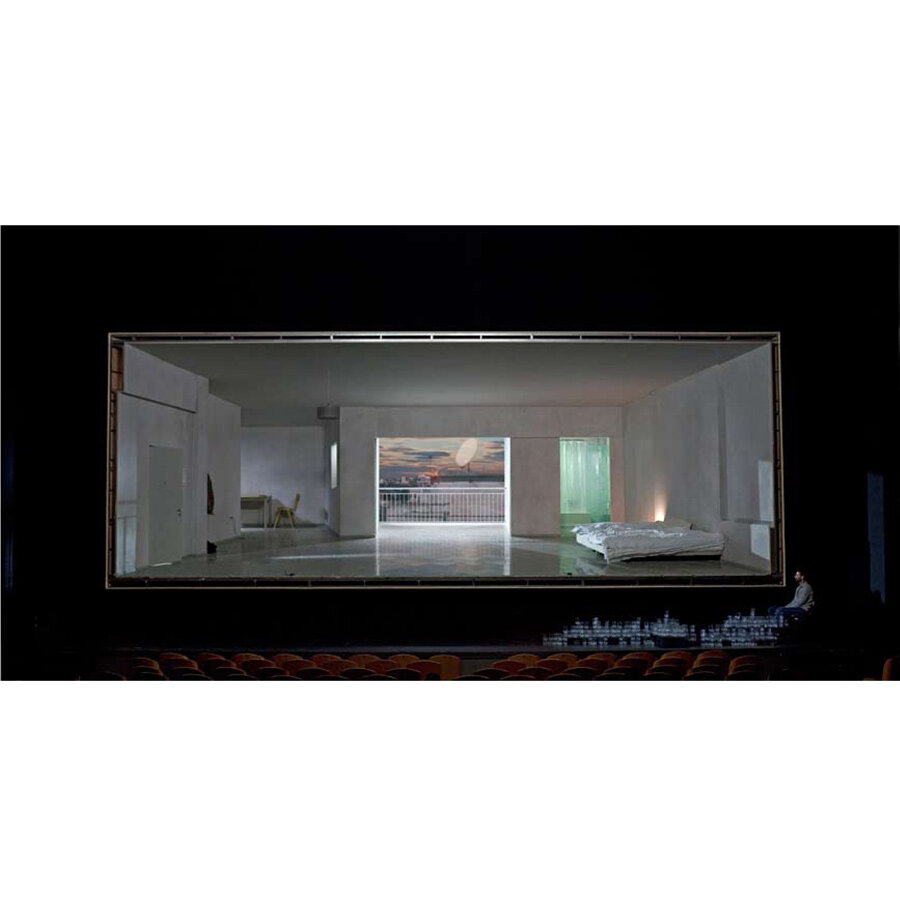
Inside by Dimitris Papaioannou (2011 - via Vimeo)

March 22, 2020

I watched Dimitris Papaioannou’s 2011 durational work Inside via Vimeo. You can watch it here.

One hour in. The patterns of movement are beautiful, subtle. When bodies overlap through spaces, they appear to be in conversation with one another - one person sits on the bed, the one lying in it adjusts, pulling up the blanket. The performers are in their own spaces, unaware of one another and yet in relationship.

The view out the window changes, and the feeling of the space changes with it, although nothing actually changes. You look away, do something else for a moment, and are surprised when you come back and the room is full, or empty.

Although the actual pace of the movements doesn’t change, the feeling of their pace seems to quicken when there are more people in view, and slow when there are fewer. It tricks the mind.

When we reach moments where the performers really do connect physically, the emotional narrative floods forward.

I’m at two hours, and continuing to watch…but want you to start too.

Tags: theatre, performance art, performance, archive, durational performance
tim.jpg

I, Malvolio by Tim Crouch (Brighton Festival 2015 - via Vimeo)

March 21, 2020

In furtherance of his status as one of the nicest humans you’ll meet, the amazing Tim Crouch has made the video archive of his performance of I, Malvolio at Brighton Festival in 2015 available without a password. You can watch it here.

Unlike most of my blogs which focus on documenting what happened, what I thought about it, etc, this will be a little different. I’ve just closed a second run of my own production of Tim’s brilliant play a few weeks ago, and have been immersed intellectually in this script for over a year. Despite that, I’ve never actually seen Tim perform the show. I’ve read about it, talked to him about it, heard him lecture on it, read reviews of it, you name it. I’ve read it countless times, torn it apart, interpreted, discussed, scenario-ized, and ultimately put it on its feet in two different venues and cities.

Watching Tim’s performance of the play was a bit surreal. First and foremost (and i knew this from seeing him perform other of his work), his performance is simultaneously highly theatrical, and completely anti-performative. He speaks and moves with complete simplicity, allowing the nature of the audience-performer relationship, the absurdity of watching people do things, lead the comedy. More importantly, though, it was fascinating to me to hear the moments of inflection, the break up of thoughts and moments in his performance versus ours. The simultaneous similarity and difference of the two was uncanny. I’ve never before experienced something like that - where two groups had clearly done the work in isolation and then come up with such similar and yet wholly different understandings of the text. This is truly a testament to Tim’s writing, the clarity with which he puts the thoughts on the page for us to pick up. Even moments of improvisation (which there are MANY) resulted in similar interactions, at times almost verbatim to things Justin said in the moment in response to an audience member’s reaction.

It is as if the character of Malvolio is so clearly described through the words, rhythm, and actions of the play, that if you do your work, there is no other choice for how to understand the intentions of the moment.

I strongly recommend watching this while it is available, especially for those who saw my production in either Toronto or Winnipeg. This production was performed for teens on a school trip.

And I emerge, once again (and perhaps even more than ever before) grateful to Tim for letting Justin and I play with his words.

Tags: Tim Crouch, I, Malvolio, shakespeare, Live Stream, recording, Directing, interactive theatre, TYA, archive
cyrano.jpeg

Cyrano de Bergerac - The Jamie Lloyd Company via NT Live

March 21, 2020

It feels like a lifetime ago that I watched this show. Since I saw it, and it subsequently closed, I have also closed a show, and in the intervening weeks, the world has quite literally turned upside down. Moments of the show stick with me in these troubling times. Lights tight on the face of a dying character, while we hear shouts and panic all around, forced to only look at the face of this man suffering. Compelling stuff in this moment.

Jamie Lloyd directs this delightfully physical interpretation, with a new script by Martin Crimp, which focuses on the language. Words are swords, words are strength. Words are shields, and they reveal us. The heightened language of the original is re-positioned as spoken word poetry, at times hip hop, with beat boxing on stage, and choreographed fights that verge into Jerome Robbins style dance fighting. The cast move as a unit through the beautiful and simple design, where sound and light are the true forces of storytelling in a way they only can possibly be in the theatre.

This is deeply theatrical work. Moments of tension, seeing others, forced to reckon with their physical presence as we hear characters talk about them. Moments of reflection, literal and psychological. Moments of tight focus, and moments of huge expanse.

James McAvoy is electric in this production. He embodies strength and vulnerability simultaneously, on the razor’s edge of desperate masculinity and intellectual strength. The cast as a whole are fantastic, but it is McAvoy’s magnetism that pulls us through. The fragility of his masculine edge, as he suppresses his intellectual tendencies is truly heartbreaking to watch - as we see his love for Roxanne manifest itself in his inability to express it to her.

Tags: theatre, Jamie Lloyd, Live Stream, NT Live, review
class.jpeg

Class - Scottee & Friends @ Progress Festival

February 23, 2020

There is something really special about this show. Living in a grey area between standup comedy, theatre, and performance art, Scottee’s Class lays bare the truths of growing up working class, and making a living as an artist. Armed with a microphone and red Adidas tracksuit, on white carpet (shoes OFF), Scottee confronts his largely middle class audience with the assumptions they have about the working class. At first playful and comedic, he brings the audience in and flatters them with comedy before turning the knife sharply, and reminding the audience that these stories are true. That they are his memories.

At the start, he asks the audience to identify as working class, or as middle class. Like the polite Canadians we are, most of the audience were shy to hold up their hands to identify as middle class, which I’m sure is not unique. For those of us who grew up working class, he reminds us this show is for them, but asks us to check in with one another afterward. I did not expect to be affected by this in the way I was. That permission to identify, the clear and honest stories of his youth, which in many real ways mirrored my own, punched me in the gut. When he warned us to check in with one another after the show, I didn’t expect to need it. I did. I had to leave the theatre quickly following the show due to other obligations, but found myself crying and grasping for breath on the phone when trying to give my husband a quick couple sentences about what I had just seen.


Scottee’s work is meaningful and powerful, and so important for people to see.

Tags: review, Festivals, Progress Festival, new work, theatre, performance art
I_Malvilio_FB-Ad_12-02-12.png

ShakespeareFest from afar

February 02, 2020

This has been a first for me; leaving a show behind to run in a city, without me.

Not to say I typically attend every performance of a show I’ve directed. Typically I’ll attend a couple times, but otherwise let them run. But somehow leaving the city, switching my brain to a new show while that team are still invested and living in the first, is. . . difficult. You are one foot in each world.

I’m so grateful to the work of my amazing team who are supporting I, Malvolio in Winnipeg. Justin’s amazing work continues to be supported and facilitated by our amazing stage manager, Leah Borchert, and two outstanding associate producers, Reba Terlson and Lizzie Knowles. Audiences are so wonderful and generous - it is heartwarming to see texts or messages from friends who are seeing it, sharing their thoughts. It is powerful work, unlike a lot of theatre experiences I’ve even had myself, so it is somewhat terrifying and feels like a bit of hubris to try to bring it to others.

There are performances remaining February 2, 3 and 5, 6, 7. Tickets are still available. This is the last show I’ll have in Winnipeg for awhile, for sure. The last one was in 2017, and before that 2015 (when I lived there…)…so at this pace it could be 2023 before I bring another. I love bringing work to my hometown, the quirky, wonderful, supporting arts community that enabled and encouraged my nonsensical experiments. That made me feel like i could challenge attending RADA, and that I could bring unique work to Toronto. I hope you all can catch one of the last performances. If you’ve already seen it, thank you. Tell a friend.

Tickets are $15, or $12 if you are a student, unemployed, artist, senior — or if you also see our host company and producing partner The Keep Theatre’s Twelfth Night (conveniently scheduled at 7:30pm nightly, so you can come straight upstairs and see our I, Malolio!). Reserve by emailing tickets@impeltheatre.com

Also, check out a zillion other bits of Shakespeare this week - I personally adored Othello, (O)Phelia, and have heard amazing things about Queen Lear is Dead. Also it HURTS that I can’t see either Hamlet that is happening.

Justin Otto as Malvolio in I, Malvolio by Tim Crouch.  Photo by Leah Borchert, audience quote from Hannah Foulger.

Justin Otto as Malvolio in I, Malvolio by Tim Crouch.
Photo by Leah Borchert, audience quote from Hannah Foulger.


Tags: theatre, Winnipeg, ShakespeareFest, shakespeare, experimental theatre, immersive, interactive theatre, producing
81987632_10219072287811266_5463038627728588800_o.jpg

(O)Phelia - Saucy Gal Productions @ RMTC ShakespeareFest

January 26, 2020

Leigh-Anne Kehler seems to step up to the task each year of the Master Playwright Festival, writing a thoughtful and well researched response to the playwright’s work. This year, she seems to have topped herself again, writing a 45 minute play expanding on the experiences of the two women in Hamlet - Ophelia, and Gertrude.

There are countless interpretations of Hamlet, and although some re-think the relationship of Hamlet to the women (or at their worst, conflate the two women into one), it is rare to see the relationship between these two women explored. Enter Kehler’s (O)Phelia, which is written brilliantly in verse, and provides insight into what may have transpired between the women that allowed Gertrude to have knowledge of Ophelia’s death, while also helping us to understand the motivations of these two women, whose choices may otherwise be easy to judge. The piece is performed thoughtfully and intelligently by Kehler and Melissa Langdon, whose Ophelia is fiery yet sensitive.

I strongly recommend checking out this new work. It deserves a bigger audience, and future productions.

Tags: new writing, ShakespeareFest, Leigh-Ann Kehler, Winnipeg, plays, review
Ray Strachan as Othello

Ray Strachan as Othello

Othello - Beau Theatre Company @ RMTC ShakespeareFest

January 26, 2020

Beau Theatre Company share Kevin Klassen’s razor sharp adaptation of Othello, tightening the story to a cast of 6 actors, and just the essentials. Klassen plays the villainous Iago, and is almost nonchalant in his scheming, which serves to underscore the tragedy beautifully. Ray Strachan’s Othello has a wonderful range of emotions, and Olivia Raine’s Desdemona is sweet and charming. An absolute standout is Haley Vincent’s Emilia, who in a smart choice is dressed to indicate she is one of the soldiers, but still Desdemona’s lady in waiting - enabling the sense of duty Emilia feels toward Desdemona to take on a new perspective.

Staged in Dalnavert’s visitors centre, director Brenda McLean creates a thrust space, and has action taking place all over the visible space as well as behind the audience at times, giving a depth to the experience. Subtle moments of direct address keep the audience engaged and complicit, while simple choices for actor movement and stillness created tension throughout the performance.

Overall a nice adaptation with some strong performances, and well worth adding to your ShakespeareFest list!

Tags: ShakespeareFest, Othello, adaptations, Echo Theatre, Beau Theatre, review
romeo+&+juliet.png

Romeo + Juliet @ RMTC ShakespeareFest - Pocket Frock Productions

January 20, 2020

I was thrilled to kick off my ShakespeareFest adventure with a local adaptation of Romeo & Juliet, from Winnipeg collective Pocket Frock. The adaptation is described as a “hot take” on the story, it felt like an R&J for the instagram generation.

Smart edits trimmed the production down to a tight 90 minutes; the audience are lit along with the actors for the majority of the time, as the company use the small studio space to great effect. Locations are malleable, and time expands and contracts with the young lovers. Some cleverly selected and then adapted pop songs further serve to create this feeling (and are performed beautifully by the multi-talented cast).

Many casting decisions are smart here, notably Jane Burpee, whose Friar Lawrence becomes a caring grandmother type, as well as Hera Nalam who delightfully inhabits young Romeo, perfectly capturing the tempestuous and highly emotional teen. By eliminating the majority of adult characters, this production served to underscore that these are just kids, who make impetuous and seemingly irrational decisions that have huge consequences.

There were some moments that could have been even more clearly created, in particular Romeo’s first meeting of Juliet, and the ongoing beef between Tybalt and Mercutio, however on the whole this was a smart adaptation and clever production.

Tags: review, shakespeare, adaptations, ShakespeareFest, Master Playwright Festival, Winnipeg, theatre
Newer / Older
Back to Top