If you had told me that the first play I saw at Avignon Festival would be interactive, or in French, or a critical view of bourgeois productions of The Seagull and Jeanne D’Arc….I would have believed you. If you had also told me that production would be in a recreation centre in a tiny village 30 mins by bus up the hill from Avignon, where there are no busses back after 8pm….that I may not have believed. Much less that this would be where I would see a fresh new Milo Rau production.
Each year, the festival commissions an artist to create a work that has specific restrictions; it must be performable in French or German, have no more than 2 actors, and must be able to be performed anywhere, and with minimal set. These productions tour following the festival each year.
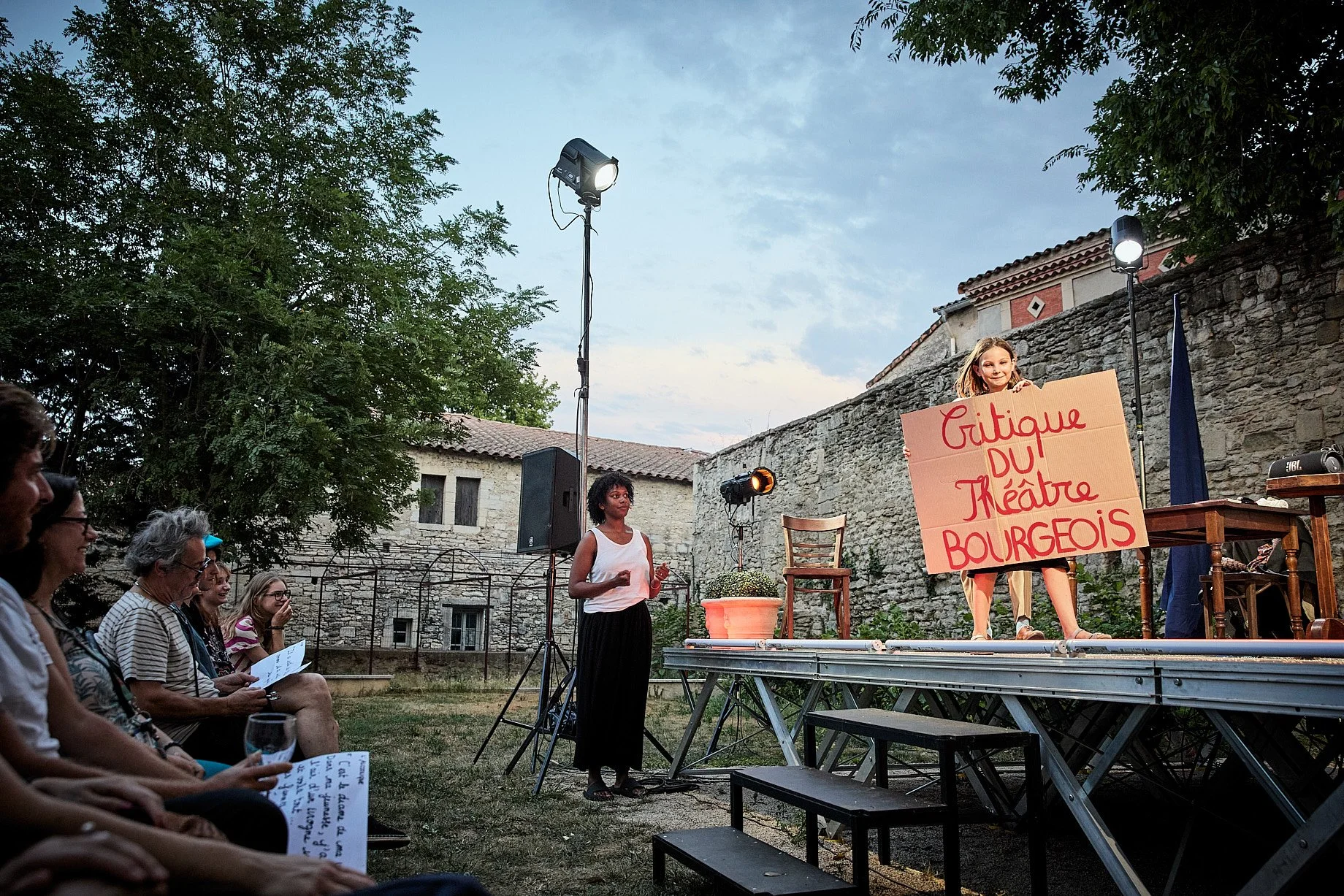
Milo Rau’s La Lettre was this year’s offering. Starting from the premise of an actor receiving a letter from a relative, and subsequently diving into themes of imagination, dreams, expectations, and the struggle of an artistic life, the two performers were captivating throughout. Indeed, while the play explored huge themes, nothing really happened. In the best way possible. Reckoning with these themes, in the shadow of these two huge plays and the expectations that come with them, the production was wildly simple in its execution. The audience were less auditors than full fledged participants — not least through literally giving printed text and props to some members, including one who acted like a ringside model at a boxing match, carrying titles across the stage in a delightfully self referential titling that Brecht would have been proud of.
We were always aware it was a play. That plays are weird and strange. That sitting in the dark watching people pretend is odd. And yet while it was a critique of theatre, La Lettre was also a love letter to theatre itself. To imagination and playfulness, and not taking ourselves too seriously.